
Home Page › Forums › Discussion Topics – Ask the Experts › Rocket Fluid Injection System
- This topic has 0 replies, 1 voice, and was last updated 15 years, 11 months ago by
 perkinsra.

-
AuthorPosts
-
March 15, 2010 at 2:06 am #7074
 perkinsraParticipant
Jan 8 2010, 10:37 AM
Oliver
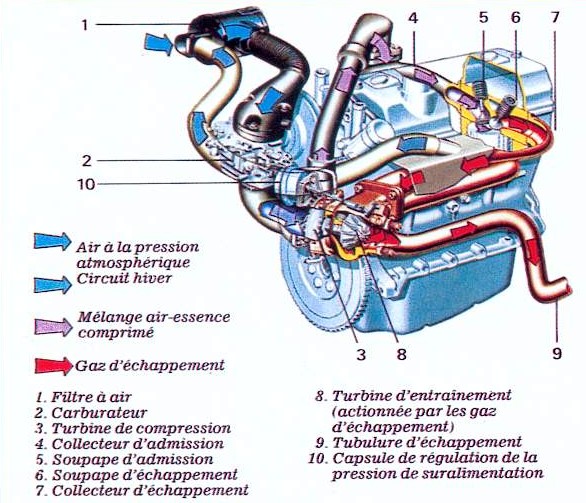
Rocket Fluid Injection SystemDear Sirs, I´m writing from Germany. I don´t own a Jet-Fire, but I have a Car with an turbo engine, that also has the the carburator before the compressor. It´s the engine of the R5 Alpine Turbo, probably you don´t know it… What I would like to get here is more detailed information how the rocket fluid injection system did work. In detail: – Where was the fluid injection located in the charger-system? – How did it work? (e.g. Where was the pressure, from?) – How was the fluid amount controlled (revolution / load?!?), how much whatever was injected? – What kind of nozzle was used? – What was the rocket-fluid (water+ethanol+???) I´m happy for any information. Thank you and best regards Oliver
————————————————————–
Jan 16 2010, 4:16 AM
Ajbarrell
Rocket Fluid Injection SystemOliver, Let me say, that looks like a first-class job fabricating that exhaust pipe. It looks like you’re going to have a nice setup when you’re done. I don’t know if you’re aware, but the fluid injection system purpose was to control detonation (1). The Olds 215c.i. V-8 engine had a 10.25 compression ratio before they added the turbocharger (2). The engineers found that even with the limited boost provided by the relatively small turbo, they had a problem with detonation. “Turbo-Rocket Fluid” was an equal-parts mix of distilled water and methyl alcohol, along with a bit of rust inhibitor (3). The mixture was used to control detonation. As far as controlling detonation goes, I’m not sure you want to go the same route as the Oldsmobile engineers did. They were limited by their early 1960’s technology. I would imagine that you could find a modern, computer controlled boost limiting system that would be much more efficient. I’ve attached a pdf file of the 1963 Olds service manual chapter that describes the Jetfire fluid injection system. You’ll see that it is pretty complicated. In fact, in 1965, Oldsmobile recalled the Jetfires and replaced the turbo/fluid injection system on many cars with a conventional four barrel carburetor because so many owners were not happy with them. If you’re still interested, study the attachment and see if you can contact Jim Noel. He might be the smartest expert on the Jetfire induction system.
Good luck and post more pictures, Tony (1) 1963 Oldsmobile Service Manual page 8-139 (2) 1963 Oldsmobile Service Manual page 1-3 (3) http://auto.howstuffworks.com/1962-1963-oldsmobile-f85-jetfire2.htm (4) http://auto.howstuffworks.com/1962-1963-oldsmobile-f85-jetfire6.htm————————————————————–
Jan 17 2010, 5:33 PM
Oliver
Re: Rocket Fluid Injection SystemHi Tony, first of all let me thank you very much. Now I see the complexity of the entire system. I know that the main reason for that system was the high compression ratio (in these days) for a turbo charged engine. Sure there are electronically controlled water injection systems available, but then I could also replace my two-barrel Weber 32DIR carburetor against a single barrel pressurized unit and install a inter-cooler. But I want to keep the technology that was available in the late seventies. Basically with my engine I have the same problems, even if with a compression ratio of 8.8:1 when you increase the charge-pressure the engine begins to knock (also with 98octane fuel and lead-substitute) and has also a detonation problem. Water-injection would solve both…. this a schematic of the alpine turbo engine: http://bgracing.free.fr/coupe_moteur_5Alpine_turbo1.jpg Now I will study what you have posted. Best regards Oliver
————————————————————–
Jan 26 2010, 1:54 PM
Oliver
Re: Rocket Fluid Injection SystemHello, now I worked through the material that you have posted. There is one question left. Which components of the system are stand alone and which are part of the carburetor?
Thanks and best regards Oliver -
AuthorPosts

- You must be logged in to reply to this topic.