

-

Jim Noel replied to the topic 70 W-30 Project in the forum Discussion Topics – Ask the Experts 10 years, 9 months ago
The 442-W30 looks great, good work!!
-
Jim Noel replied to the topic Seat Belt Installation in the forum Discussion Topics – Ask the Experts 10 years, 9 months ago
You are correct, all 1962/3 F-85’s came with seat belt anchor nuts welded to the floor pan for the front seats. If still original, the nuts will have rubber plugs in the bolt holes. I have not seen any with rear seat belt anchor nuts in the floor pan. They only showed where dimples were put into the rear floor pan to drill holes for rear seat belt…[Read more]
-
Jim Noel replied to the topic 63 f85 windshield trim please help. in the forum Discussion Topics – Ask the Experts 10 years, 10 months ago
There are two different styles of trim for a windshield. As mentioned in the previous article by BruceM, glue in and rubber gasket styles. You will get a better result/response if you state how your windshield is affixed to the frame.
-
Jim Noel replied to the topic New Toy for Jim in the forum Discussion Topics – Ask the Experts 10 years, 11 months ago
The cradle mounts are bolted tight and complete engine/trans connections will be next, electrical, cooling, fuel, drive line, etc.
The trim and interior are in progress too. -
Jim Noel replied to the topic New Toy for Jim in the forum Discussion Topics – Ask the Experts 10 years, 11 months ago
Now it is time to put the completed engine/trans in the engine bay. I lift up the body and lower it onto the front cradle/engine assembly.
-
Jim Noel replied to the topic New Toy for Jim in the forum Discussion Topics – Ask the Experts 10 years, 11 months ago
I am making progress on my re-assemble but I am slow!Finished the prep of the engine bay, now ready for the turborocket!
-
Jim Noel replied to the topic Seal for prop shaft in the forum Discussion Topics – Ask the Experts 11 years ago
Here are the front and rear seals for the Roto 5 on EBay.
http://www.ebay.com/itm/FRONT-REAR-SEAL-Roto-5-240-Oldsmobile-F85-Olds-Transmission-1961-1962-1963-/310859457900?pt=Vintage_Car_Truck_Parts_Accessories&hash=item4860aae56c&vxp=mtr -
Jim Noel replied to the topic Seal for prop shaft in the forum Discussion Topics – Ask the Experts 11 years ago
Here are the front and rear seals for the Roto 5 on EBay.
http://www.ebay.com/itm/FRONT-REAR-SEAL-Roto-5-240-Oldsmobile-F85-Olds-Transmission-1961-1962-1963-/310859457900?pt=Vintage_Car_Truck_Parts_Accessories&hash=item4860aae56c&vxp=mtr -
Jim Noel replied to the topic New Toy for Jim in the forum Discussion Topics – Ask the Experts 11 years, 1 month ago
Engine clean up/restoration for this car was a water based chemical wash in a commercial parts washer. The heads and block cleaned up without any stain marks or discoloration. I was surprised on how good they came out of the wash cycle too. The intake manifold was painted after clean up.
-
Jim Noel replied to the topic New Toy for Jim in the forum Discussion Topics – Ask the Experts 11 years, 1 month ago
The body is painted, back home and ready to detail with all the unique Jetfire trim!
-
Jim Noel replied to the topic New Toy for Jim in the forum Discussion Topics – Ask the Experts 11 years, 1 month ago
Here the engine is attached through the motor mounts and all except the power steering pump connected.
-
Jim Noel replied to the topic New Toy for Jim in the forum Discussion Topics – Ask the Experts 11 years, 1 month ago
Well, it is time for a few updates. My new toy project has been going somewhat slow but should start picking up speed. I now have all components ready for reassembly. The front frame/engine cradle is refurbished.
-
Jim Noel replied to the topic Are the 215 blocks drilled for pilot bushing? in the forum Discussion Topics – Ask the Experts 11 years, 5 months ago
You will only need to insert a pilot bushing to fit the transmission you are using. The crankshaft has the hole for the bushing. It has nothing to do with the block, only the crankshaft.
-
Jim Noel replied to the topic Jetfire Heater Hoses in the forum Discussion Topics – Ask the Experts 11 years, 6 months ago
Yes, the upper “J” shaped hose is specific to Jetfire.
Naw, it is a little rough right now. Maybe next spring. She is getting a full make over. -
Jim Noel started the topic Jetfire Heater Hoses in the forum Discussion Topics – Ask the Experts 11 years, 6 months ago
I have found replacement heater hoses for the Jetfires. Both are current Gates pre-molded hoses and are very close to the originals. Both should be useable with some trimming.
The lower “S” shape is Gates #19604 and the upper “J” shape is Gates #21860. -
Jim Noel replied to the topic rochester r/rc, jetfire carb pics in the forum Discussion Topics – Ask the Experts 11 years, 7 months ago
Yes, the large brass lines are for engine coolant to run through the throttle body. The coolant also runs through the compressor housing side of the turbo unit. The factory stock turbo engine has 10.25 to 1 compression ratio and needed a method to reduce pre-ignition caused by the piston tops and heads getting too hot under boost. Modern day turbo…[Read more]
-
Jim Noel replied to the topic rochester r/rc, jetfire carb pics in the forum Discussion Topics – Ask the Experts 11 years, 7 months ago
It would be easier if I knew just what you want to do? All you need to make the carb function is supply fuel. If you are NOT going to use the Turbo Rocket Fluid injection system or boost control parts, then you will need to block all the ports on the carb and throttle body, including the water preheat lines going to the throttle body. You will…[Read more]
-
Jim Noel wrote a new post 11 years, 9 months ago
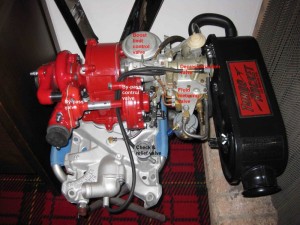
Click to enlarge picture The safety components of the factory designed turbo system have some interactive groups of safety “checks”. They are as follows:
1. The exhaust gas by-pass valve works independent of all other safety systems. It is controlled by the by-pass control valve and maintains the amount of boost that the turbo can produce. It will keep the turbine rotation in the 90,000 RPM maximum range and boost at 6 to 8 pounds of pressure. This safety system is still a part of all modern turbos. This system is independent of all other Jetfire safety systems. I have been told that this turbine is capable of rotation up to 150,000 RPM on the 215 CID engine and would produce some 21 pounds of boost. The engine would “come apart” without this by-pass control.
2. The anti-detonation fluid delivery systems are necessary to keep the combustion chambers “cool”. Modern turbo systems accomplish this by controlling the spark timing to a much earlier spark plug fire, a technique that was not controllable or available in 1962. The safety systems put in place to be sure that the anti-detonation fluid system is doing its job, are where all the problems occur.
2a. The Check and Relief valve (C&R valve), located in the intake manifold, is the “pump” to deliver the anti-detonation fluid to the combustion chambers via the throttle body. When boost pressure is present in the intake manifold, the bottom vacuum seal valve in this C&R valve opens up and allows manifold pressure to flow to the top of the anti-detonation fluid tank, pressurizing the fluid delivery system. Once the fluid tank is pressurized, it remains pressurized by the vacuum seal valve in the bottom of the C&R valve and the fluid metering valve system takes over the delivery task. The top relief valve in the C&R is a complex diaphragm/valve system. Its function is to relieve any excess pressure in the fluid storage tank that may build up once the tank is pressurized and thermal expansion causes a slight increase of pressure. This small bleed off valve at the top of the C&R valve is in place to keep the fluid storage tank pressure cap from popping, that would require a manual reset under the hood. The fluid storage tank pressure cap will pop off at 6-1/2 to 7-1/2 pounds and requires a manual reset by pushing the red button down in the center of the cap. Must stop the car, get out and open the hood and reset the pop off button in the pressure cap before you can resume driving with a functional turbo! It is possible that you could by-pass this 2nd complex safety system with a very good and sensitive pressure, automatic relief and reset, “radiator” style cap on the top of the fluid storage tank. For some reason the Olds engineers didn’t think this was reliable enough?
2b. The anti-detonation fluid (Turbo Rocket Fluid) metering system receives the anti-detonation fluid from the pressurized storage tank and injects the fluid into the throttle body for flow into the intake manifold then the combustion chambers. The volume of fluid is controlled by the fluid metering valve and starts its flow at the first sign of positive pressure/boost in the intake manifold. The volume of anti-detonation fluid injected into the throttle body increases with the increase of manifold/boost pressure. The consumption of Turbo Rocket Fluid from the 5 quart tank will vary from consuming all 5 quarts in less than 125 miles under heavy acceleration to some 3,000 miles under normal driving conditions. When the fluid tank goes empty, the manifold pressure developed under turbo boost flows through the anti-detonation fluid metering system to the boost limit controller that restricts the throttle body intake air flow, via a throttle plate in the throttle body, drastically reducing the performance of the engine. The engine will run and cruise under normal acceleration but will “baulk” under any full acceleration attempts.
2c. The boost limit control valve operates an intake air volume baffle in the throttle body. This safety control can also be by-passed by disconnecting the operating arm coming out of the valve body that connects to the baffle operating lever. This would allow the turbo boost to be always present under heavy acceleration but without the combustion chamber being cooled from the Turbo Rocket Fluid. The engine could/would be harmed in a short period of time!
3. The depressurization valve relief system vents the stored up tank pressure after engine shut down. This is necessary to keep the Turbo Rocket Fluid from going through the fluid metering system, then through the throttle body into the intake manifold, down an open intake valve into a combustion chamber/cylinder and causing what is known as “hydraulicing” the piston on the next engine start up. This can break a piston, bend a connecting rod or crack the head. The original depressurization valve is built into the throttle body. It was designed too small, with too thin a diaphragm material and too prone to plugging with any small particles of crud to be relied on for the long haul. In June of 1964, a “service correction” an early form of a “factory recall” was sent to all Oldsmobile dealers. A new external depressurization valve was to be added to all known Jetfire cars. This correction is very important to keep your Jetfire engine “safe”.With all of this being stated, safety system 1 controls the RPM spin of the turbine, limiting the boost pressure to some 6 to 8 pounds. Safety system 2 has redundant checks to be sure the anti-detonation fluid is present when boost is experienced. Safety system 3 is to keep the Turbo Rocket Fluid out of your engine after shut down. All 3 are necessary for safe operation. Yes, modern parts and procedures could be substituted to keep the Jetfire operational as long as they limit the boost pressure, keep the combustion chambers cool under boost and keep fluid out of the cylinders when not running. The elimination of any of the original safety features should be replaced with something that will accomplish the same job.
-
Jim Noel replied to the topic Just in case you haven't noticed in the forum Discussion Topics – Ask the Experts 11 years, 10 months ago
Greg’s 1962 Jetfire just sold in an eBay auction for $42,100. A new HIGH for any Jetfire! Congrats Greg, you/your car just “raised the bar” for our little turborockets!
-
Jim Noel started the topic Just in case you haven't noticed in the forum Discussion Topics – Ask the Experts 11 years, 10 months ago
There is a Jetfire for sale on eBay. They are still getting good action! http://www.ebay.com/itm/221423414942
Jim - Load More
